The phone rings at 8:47 p.m. A homeowner’s AC has failed, the house is getting hotter, and they want someone tonight. Your techs are done for the day. You’re with family, on another call, or aren’t watching the office line. The caller gets voicemail, hangs up, and moves to the next HVAC company.
That loss is easy to miss because nothing breaks inside your process. No invoice gets voided. No dispatcher logs a complaint. The lead just disappears. Most owners feel the symptom, not the cause. They think the problem is inconsistent lead flow, weak follow-up, or seasonality. Sometimes it’s simpler than that. The phone wasn’t answered when the customer was ready to book.
That’s why an HVAC answering service matters. It isn’t just a convenience for nights and weekends. It’s a front-end operations tool that protects revenue, captures demand when your team is busy, and keeps urgent situations from sitting in a mailbox. If you’re already investing in marketing, service vehicles, and dispatch capacity, you also need a reliable way to catch the work that’s trying to reach you. If you want more demand in the first place, this guide to getting HVAC leads online is also useful because lead generation only works when somebody answers.
Table of Contents
Introduction You’re Losing Jobs You Don’t Even Know About
At 6:12 p.m. on a hot Tuesday, your office is closed, your install coordinator is off the clock, and a homeowner with a dead system calls for help. If nobody answers, that call does not sit in a neutral holding pattern. It turns into revenue for the contractor who picked up first.
That loss is easy to miss because it rarely shows up as a clean line item on a report. The customer does not fill out a cancellation form. They do not tell your dispatcher they hired someone else. The opportunity disappears before your team can price the job, explain timing, or get the call onto the board.
HVAC companies feel this every day because demand shows up at the wrong times. Systems fail after hours. Weekend weather spikes call volume. Technicians are in attics, on roofs, or driving between jobs when the phone rings. Office staff can only cover so much.
The result is an operations problem with a revenue consequence.
A missed call is not just a missed conversation. It is a broken intake process. If your business depends on inbound demand, every unanswered call creates three risks at once: lost booked work, a weaker customer experience, and more pressure on the owner or dispatcher to patch the gap manually.
That is why an HVAC answering service matters. Its core value is not that someone says hello. The value is that incoming demand gets captured, sorted, and turned into the right next action without forcing your field team to become part-time receptionists.
I tell HVAC owners to look at this the same way they look at lead generation. Spending money to drive calls, then letting those calls roll to voicemail, is a margin problem. If you are investing in ads, Local Service Ads, SEO, or using a guide to getting HVAC leads online, your call handling process has to protect that spend.
The trade-off is straightforward. A cheap service that only takes messages gives you coverage on paper, but it can still leave money on the table if follow-up is slow or incomplete. A well-run answering service helps you book more jobs, protect after-hours demand, and scale without adding full-time payroll before the call volume supports it.
That operating difference is what separates a busy company from one that grows with control.
What an HVAC Answering Service Actually Does
A modern HVAC answering service should work like a remote front desk tied to dispatch logic. If it only takes a name and number, it’s not solving the core problem. It’s moving the delay from voicemail to a human.
It starts with triage, not message taking
The first job is classification. Incoming calls should be sorted into at least three operational buckets: emergency service, revenue-generating sales or estimate requests, and routine scheduling or billing inquiries, based on HVAC answering service guidance from Answering365.
That triage matters because each call type needs a different outcome.
Emergency service calls: No-cool, no-heat, gas smell, and water leak situations should trigger the on-call workflow.
Sales and estimate requests: New system quotes, replacement consultations, and installation questions should be captured cleanly for prompt follow-up.
Routine office matters: Reschedules, invoices, maintenance plan questions, and basic status checks usually don’t require waking up a technician.
A capable provider should also support structured workflows similar to a call handling service for small business operations, where calls aren’t just answered but routed according to urgency and business rules.
The intake details determine whether follow-up works
If the service doesn’t collect the right details, the next step breaks. Good intake usually includes the caller’s identity, service address, equipment type, symptoms, urgency, and preferred callback window. That gives dispatch or office staff enough context to act without replaying the whole conversation.
Here’s what works in the field:
Call type | What the service should collect | Expected action |
|---|---|---|
Emergency repair | Name, address, callback number, symptoms, urgency | Notify on-call tech or dispatcher immediately |
Estimate request | Property type, job type, timeline, contact info | Queue for sales follow-up |
Routine inquiry | Account context, issue summary, preferred contact time | Send to office for next-business-day response |
Practical rule: If your answering partner can’t explain its emergency triage process in plain language, it probably isn’t built for HVAC.
What doesn’t work is a generic script that treats every call the same. A midnight no-heat call and a request for a spring tune-up shouldn’t enter the same queue with the same handling rules. HVAC companies need call management, not polite note taking.
Business Case for Never Missing a Call
A missed HVAC call rarely feels expensive in the moment. It feels like office noise. Then the week ends, the board is not as full as it should be, and the marketing bill still has to be paid.
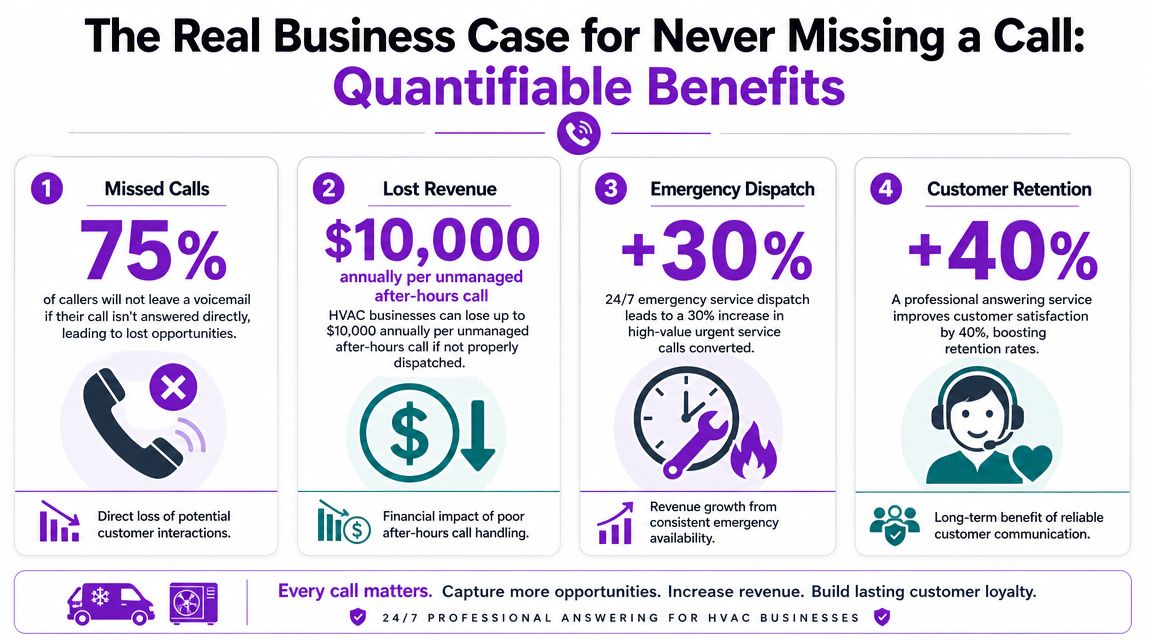
Missed calls reduce return on every lead source
Owners often evaluate an answering service as an overhead decision. In practice, it is a revenue protection decision.
Every inbound call already carries acquisition cost behind it. You paid for Google Ads, SEO, trucks on the road, review generation, yard signs, or repeat-brand recognition in your market. If nobody answers, that spend produces less revenue than it should. The loss is bigger than one repair call. You also lose replacement opportunities, maintenance conversions, and future repeat business from a household that called someone else first.
This also affects how hard your marketing has to work. Companies trying to improve HVAC Google Maps rankings need strong phone coverage to turn that visibility into booked jobs. More inbound demand only helps if the business can catch it consistently.
Speed matters because HVAC buyers do not wait
Customers with no cooling in July or no heat on a cold night do not build a careful shortlist. They call the next company that picks up.
That changes the way owners should look at response time. The goal is not merely to sound professional. The goal is to keep the call in your pipeline long enough to book it, dispatch it, or hand it to the office with enough detail to close it fast.
An answering service improves that flow in a few concrete ways:
More calls turn into scheduled work because a live answer keeps the customer engaged.
Urgent jobs reach the on-call process faster so the delay happens in dispatch, not at the first point of contact.
Sales inquiries arrive cleaner with contact details and job context your office can use.
The front office stays productive because staff are not constantly pulled off billing, scheduling, and customer updates to catch overflow calls.
That is the operational payoff. Fewer dropped opportunities. Better use of technician capacity. Less administrative drag.
The ROI shows up in booked jobs and smoother capacity planning
I usually tell HVAC owners to stop asking, “What does the service cost per month?” and start asking, “How many calls do we miss, and what is one recovered job worth?”
If your average repair ticket is meaningful, you do not need many saved calls each month to cover the service fee. If your team also sells maintenance agreements or identifies replacement leads during service calls, the upside grows from there. One answered after-hours call can turn into a repair today, a system sale later, and a customer who stays with you for years.
The operational side matters too. A business that answers consistently can spread work more evenly, protect office staff from burnout, and support growth without adding a full-time receptionist the moment call volume rises.
That is why owners who treat call coverage as part of revenue operations usually scale more cleanly than owners who treat it as a phone expense.
Core Features to Evaluate in Your Next Answering Service
A lot of HVAC owners buy coverage and still end up with messy handoffs, bad notes, and calls that never turn into scheduled work. The service matters less than the operating system behind it.

The features that affect booked jobs
Market pricing runs from low-cost basic plans up to higher monthly tiers with more customization, call handling depth, and language support, as outlined in Ringover’s HVAC answering service overview. That range matters because you are not just comparing answering capacity. You are comparing how much operational work stays with your office after the call ends.
The right evaluation criteria are practical:
Custom call scripting: Repair calls, replacement inquiries, maintenance questions, and billing calls should not follow the same script. Good scripting gets the caller to the right path fast and captures the details your team needs.
Appointment workflow: Some services only take messages. Others can book directly or collect the exact fields your CSR needs to schedule without a second callback. That difference affects speed and close rate.
Dispatch logic: After-hours escalation should match your real on-call rules, service area, and job priority. If the provider cannot mirror your process, your technicians will feel it first.
Software compatibility: Scheduling, CRM, and automation fit matter because manual re-entry creates mistakes. If you are comparing AI-first options with traditional live agents, an automated answering service for service businesses is one model to evaluate based on workflow, not just price.
Notification quality: A dispatcher should be able to read the text or email summary and act immediately. If the note is vague, too long, or missing urgency markers, your office has to redo the intake work.
This is the test I use with clients. Ask the provider to walk through three real call types from your business: a no-cool emergency after hours, a weekend estimate request, and a maintenance customer who wants to reschedule. If the answers sound generic, the setup will be generic.
What sounds good in a sales demo but fails in the field
Bilingual support is a good example. In some shops, it directly affects whether a caller books at all. What matters is not whether the provider can technically translate. What matters is whether the caller reaches the right flow in the right language, the intake stays accurate, and your office gets a usable summary instead of a rough transcript.
I also tell owners to press on exception handling.
If a provider cannot explain how it handles duplicate callers, warranty questions, service-area screening, or calls that need to be declined politely, you will end up paying for coverage while your staff still cleans up preventable errors.
Avoid generic scripts, long message dumps, and one-size-fits-all escalation trees. Choose the service that reduces admin work, protects dispatch quality, and gives you a better shot at turning every legitimate call into revenue.
Answering Service vs In-House vs Virtual Receptionist
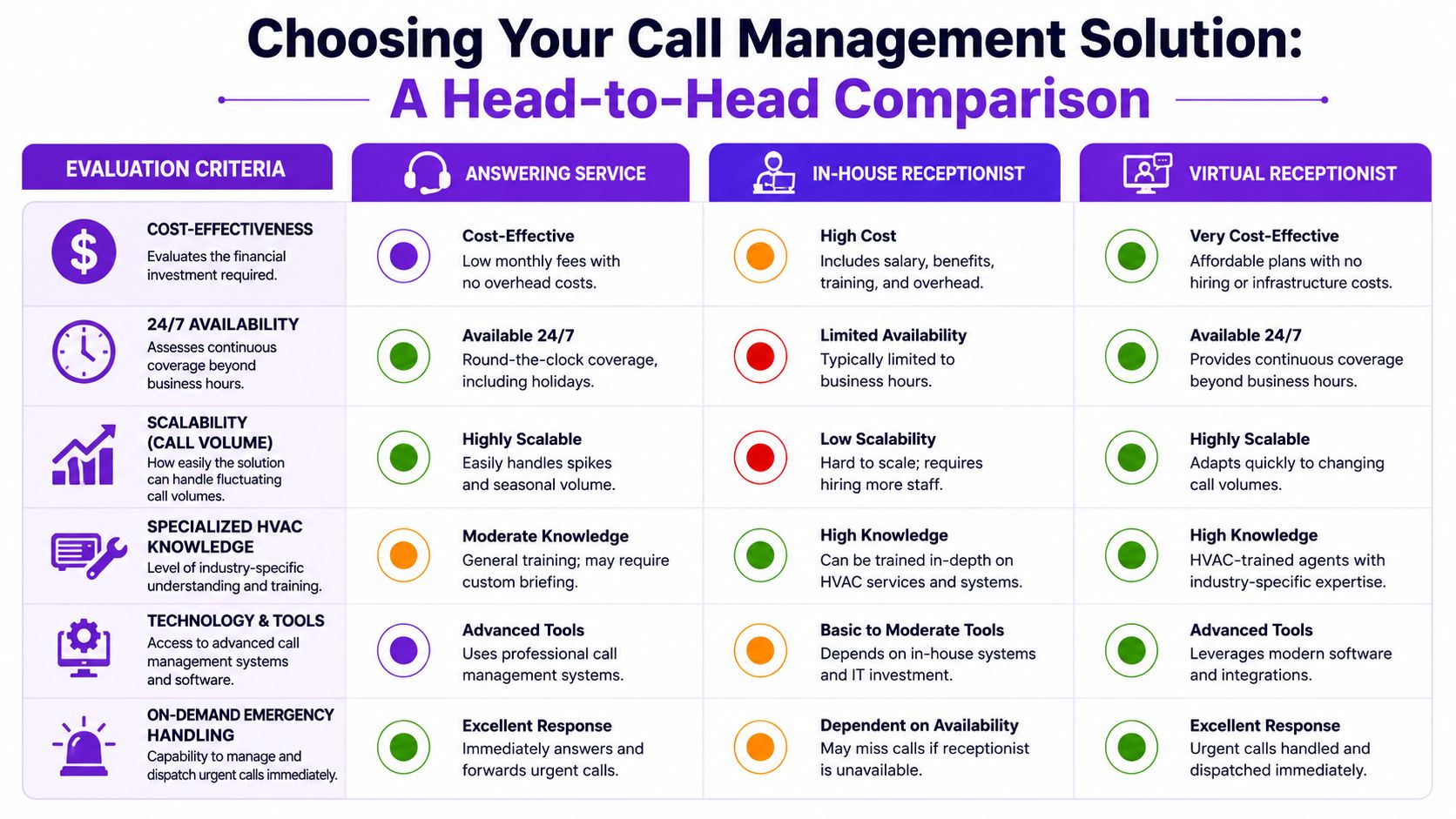
Most HVAC companies end up choosing between three models. They hire in-house, use a specialized answering service, or contract a broader virtual receptionist setup. None is automatically wrong. The right choice depends on hours, call complexity, and how much operational discipline you need.
Where each model fits
An in-house receptionist makes sense when you need someone physically connected to the office, familiar with your team, and active during regular business hours. The limitation is obvious. Coverage usually stops when the shift ends, and seasonal spikes can swamp one person fast.
A general virtual receptionist can be a step up from voicemail, especially for small shops that want a professional voice without a full-time hire. The problem is that many virtual receptionists are built to handle broad business categories, not HVAC urgency.
A specialized HVAC answering service is often the cleanest fit when the business needs after-hours triage, overflow handling, and call flows built around dispatch and service scheduling.
Option | Strongest fit | Main limitation |
|---|---|---|
In-house receptionist | Daytime office coordination | Limited hours and surge capacity |
Virtual receptionist | General call coverage | Often lacks HVAC-specific triage |
HVAC answering service | After-hours, overflow, dispatch-aware handling | Requires careful setup and scripts |
The AI versus live trade-off
One of the most useful questions today is when AI outperforms a human receptionist, and when it creates risk. Fusion CX points out that many providers talk about 24/7 coverage but rarely provide side-by-side data on call resolution, bilingual performance, or transfer rates in its analysis of answering service gaps for HVAC contractors.
That means buyers need to evaluate the workflow directly.
AI-first setups can be strong for speed, consistency, spam filtering, basic FAQs, and structured intake.
Live agent models tend to handle emotional callers and unusual situations more naturally.
Hybrid approaches can work well when routine calls are automated and edge cases route to people.
Rosie is one example of an AI-powered option in this category. It handles calls, captures messages, sends summaries, supports bilingual English and Spanish, and can book appointments or transfer priority calls. That kind of model is often worth considering for HVAC businesses that need after-hours coverage without adding office labor.
Calculating Your ROI and Understanding Pricing Models
Owners don’t need a complicated finance model to decide whether this pays off. They need a simple way to compare monthly cost against recovered work.
A simple way to run the math
Dexcomm notes that an HVAC company with 2 to 4 trucks typically pays about $125 to $350 per month for a premium answering service, and cites an average service call value of about $900, in its breakdown of HVAC answering service cost and value. That gives you a practical baseline.
Start with this basic formula:
Estimate monthly service cost
Estimate how many real calls you currently miss
Estimate how many of those would become booked jobs if answered
Compare recovered job value to the monthly fee
If one recovered service call can cover the monthly cost range above, the decision becomes operational, not theoretical. You’re not buying “phone support.” You’re protecting bookable work.
A good companion resource is this breakdown of answering service cost models and trade-offs, which helps when you’re comparing flat-rate plans against usage-based pricing.
How to read pricing without getting distracted
Don’t stop at the monthly fee. Ask what the fee includes.
Call handling scope: Does the plan cover message taking only, or scheduling and dispatch too?
After-hours rules: Are emergency escalations included in the standard workflow?
Overage exposure: Will a busy heat wave month push your bill up sharply?
Admin savings: Does your office spend less time listening to voicemails and calling people back?
Cheap plans get expensive when your staff has to reconstruct every missed conversation by hand.
The best pricing model is the one that produces clean handoffs and fewer dropped opportunities, not the one with the lowest sticker price.
Your Implementation Checklist for a Smooth Rollout
A poor setup can make a good answering service look ineffective. Most rollout problems come from missing instructions, vague scripts, or bad escalation rules.
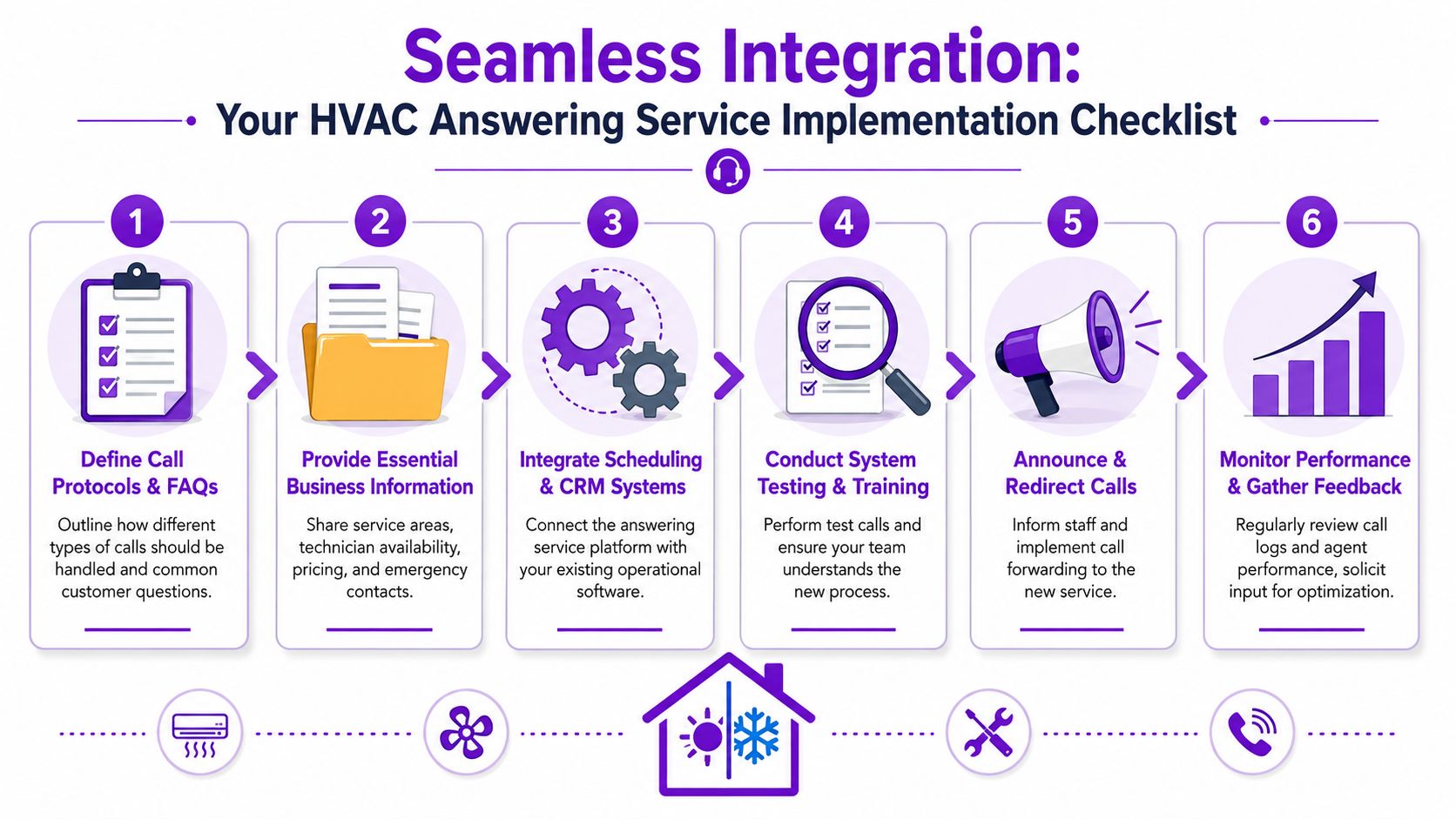
What to prepare before go-live
Get the operating details out of people’s heads and into a documented process. Your provider needs enough information to represent the business consistently.
Use this checklist:
Call categories: Define what counts as emergency, sales opportunity, and routine inquiry.
Service area rules: List cities, ZIP coverage if you use it internally, and any exclusions.
On-call schedule: Specify who gets contacted, in what order, and when escalation moves to the next person.
Basic customer-facing answers: Hours, financing availability, maintenance plan basics, brands serviced, and what you don’t service.
Booking preferences: Decide whether the service books directly, captures leads for callback, or does both depending on call type.
How to test the setup before customers depend on it
Run test calls before forwarding everything live. Don’t just test one path. Test an after-hours repair request, a replacement lead, and a routine office question. Then inspect what your team receives.
A solid rollout includes these final checks:
Message quality: Are summaries short, accurate, and actionable?
Escalation timing: Does the on-call tech get alerted the way you intended?
Customer experience: Does the greeting sound like your company, not a generic contact center?
Internal adoption: Does your dispatcher know what the service handles versus what still stays in-house?
You should also tell the field team what to expect. If technicians suddenly get after-hours transfers without context, they’ll assume the service is broken when the actual problem is training.
The cleanest implementations usually start with after-hours and overflow, then expand into scheduling and deeper workflow integration once the scripts are stable.
Frequently Asked Questions About HVAC Answering Services
Most of the hesitation around an HVAC answering service comes down to trust. Owners want to know whether someone else can protect the customer experience without creating extra cleanup work for the office.
Common concerns from HVAC owners
Can the service tell the difference between a real emergency and a customer who just thinks it’s urgent?
Yes, if you give it clear triage rules. The service shouldn’t improvise. It should follow your definition of an emergency, ask the same qualifying questions every time, and trigger your on-call process only when the answers match that standard.
How should it handle angry or frustrated callers?
The right approach is calm acknowledgment, structured intake, and a next action the caller can understand. The goal isn’t to solve the mechanical issue on the phone. It’s to lower the temperature, collect the facts, and move the call into the correct workflow.
Will callers feel like they’re talking to a robot?
That depends on the system and the setup. A good process sounds direct, clear, and competent. A bad one sounds scripted because it is scripted badly. If you use AI, test real calls. If you use live agents, test how well they stay on script without sounding detached.
What if the caller asks a technical question the agent can’t answer?
The service shouldn’t guess. It should capture the question, set expectations, and route it properly. Good call handling protects trust by being accurate, not by pretending to know more than it does.
Should the service book appointments directly?
Usually yes, for routine calls that fit your schedule rules. For complex replacements or unusual service requests, capturing a clean lead for callback is often safer.
How do you know it’s working?
Review call logs, summaries, booking outcomes, and technician feedback. If the service reduces confusion and increases useful handoffs, it’s doing the job.
If you need a system that covers calls around the clock without pulling your team off real work, Rosie is one option to review. It’s an AI-powered answering service built for small service businesses, with 24/7 call handling, bilingual support, appointment options, call summaries, and priority transfers that fit common HVAC after-hours and overflow workflows.