You’re halfway through a showing. Your phone buzzes in your pocket. Unknown number. Good chance it’s someone calling from the sign on another listing, or a seller who finally decided to reach out while motivation is high. You can’t answer without derailing the conversation in front of you, so the call goes to voicemail.
That’s how real estate leads disappear.
A real estate answering service fixes that by picking up, qualifying the caller, answering the basics, and getting the next step locked in while you keep working. If you want a version built for this kind of workflow, Rosie offers a real estate answering service for agents and teams.
You’ll leave this guide knowing:
How to stop losing buyer and seller inquiries when you’re busy
How to compare live, AI, and hybrid answering models without guessing
How to set up scripts and handoffs that help you close deals
If you already know missed calls are costing you business, you can get started with Rosie here.
Table of Contents
Introduction
The call almost never comes at a convenient time.
It comes when you’re entering a property, driving between appointments, talking a nervous seller off the ledge, or trying to write an offer before someone else gets there first. In real estate, your day is full of moments where answering the phone matters and isn’t possible at the same time.
That’s why a real estate answering service has shifted from a nice extra to a core operating tool. The right setup doesn’t just take messages. It screens spam, qualifies real leads, books the next step, and gets urgent calls to the right person without turning your day into chaos.
If your phone is running your schedule instead of supporting it, there’s a cleaner way to handle it.
Missed Call Cost in Real Estate
A buyer calls from the curb after spotting your sign. You are in a listing appointment, so it rolls to voicemail. Ten minutes later, that buyer has already called another agent, booked a showing, and started a conversation you never got a chance to have.
That is the cost problem agents feel every week. One unanswered call can mean a lost lead, a weaker first impression, and a pipeline that looks healthier on paper than it really is.
The bigger issue is timing. Phone leads usually show the highest intent at the moment they call. If no one answers, many callers do not wait around for a callback. They keep going until they reach someone who can help now. As noted earlier in Nextiva’s real estate answering service guide, real estate inquiries still rely heavily on phone response, especially after hours and during overflow periods, which is why missed calls can turn directly into missed commission opportunities.
I have seen agents underestimate this because they count only the obvious loss. They remember the buyer they never reached again. They miss the seller who opted for a more responsive competitor, or the investor who decided your team was too slow for serious deals.
It also affects your conversion math.
If your marketing generates calls from signs, listing portals, Google Business Profile, and referrals, every missed call lowers the return on all of that spend and effort. The ad may have worked. The sign may have worked. Your reputation may have done its job. But the lead still slips away if the handoff at the phone breaks.
That same expectation shows up across service businesses. Francisco Fierro of Iron Volt Electric described it this way:
“Before Rosie, missed calls meant missed jobs. When the crew is out in the field all day, no one can stop to answer the phone… Now I don’t have to stress about missed calls. Rosie picks up automatically so every caller gets a response even when we’re tied up on a job.”
Real estate has the same operational pressure, just with higher transaction values and more emotional urgency.
For Florida agents, even vendor relationships are shaped by responsiveness. Guides like this one on real estate media for Florida agents resonate because everyone around a listing is working on tight timelines, and delays cost momentum.
Availability affects how clients judge you
Clients do not separate your market knowledge from your responsiveness. They experience both as one thing.
A seller who leaves a voicemail and waits half a day does not think, “My agent is busy closing deals.” They often think, “Will this be the communication standard once I sign?” A buyer who cannot reach you on a hot listing may never complain. They just call the next name.
That is why availability is an operations issue first, and a branding issue second. If your workflow depends on you being personally free every time the phone rings, growth creates friction. More listings, more ad spend, and more referrals produce more call spikes. At some point, the very work that should grow the business starts causing lead leakage.
That is also why 24/7 availability matters for real estate lead capture and client trust. The problem is rarely effort. The problem is that a solo phone workflow does not hold up once call volume becomes unpredictable.
What a real estate answering service actually does

It covers the calls that come in while you are working
A real estate answering service sits in the gap between lead interest and your availability.
That gap shows up constantly. You are in a showing, negotiating inspection items, driving between appointments, or talking to a seller who needs your full attention. Meanwhile, a buyer calls about a listing they just saw, a past client refers a friend, or a tenant has a time-sensitive issue. The service answers, keeps the conversation moving, and makes sure the call does not die in voicemail.
The job is broader than answering after-hours calls. A good service handles overflow during the day, captures lead details while intent is still high, routes urgent issues fast, and helps with scheduling when the caller is ready to take the next step.
That means it should know how to handle calls like:
Buyer inquiries: Questions about a listing, tour availability, financing status, and next steps
Seller leads: Early qualification around timeline, property type, motivation, and location
Urgent issues: Tenant or property problems that need immediate routing
Overflow calls: Times when you are already on another call, in an appointment, or off for the day
It pushes the conversation toward a clear next action
This is the difference between call coverage and message taking.
If the service only collects a name and number, you still have the same bottleneck. You call back cold, you waste time reconstructing context, and high-intent leads cool off while you sort through notes. The better setup captures enough information for a useful handoff, so you know who called, why they called, how serious they sound, and what should happen next.
In practice, that workflow usually includes:
Greeting the caller in your brand voice
Identifying the call type, such as buyer, seller, tenant, vendor, or spam
Collecting details tied to the reason for the call
Answering common questions from your approved business information
Booking, transferring, or sending a clean summary for follow-up
Services like Rosie fit this active call-handling model. Rather than stopping at message taking, Rosie can qualify leads, answer routine questions from your business information, book appointments, and transfer calls based on your rules.
A good answering service protects your attention and gives the caller a useful next step.
That point matters more than the feature list. If your current setup still leaves you listening to voicemails in the car and guessing whether “call me back about the house on Maple” came from a serious buyer or a casual browser, the process is still broken. You do not need more messages. You need cleaner intake and a faster handoff.
Key features every agent should look for
Feature checklists are useful, but the better question is simpler: will this setup save time during a busy day and help convert more of the calls you miss?
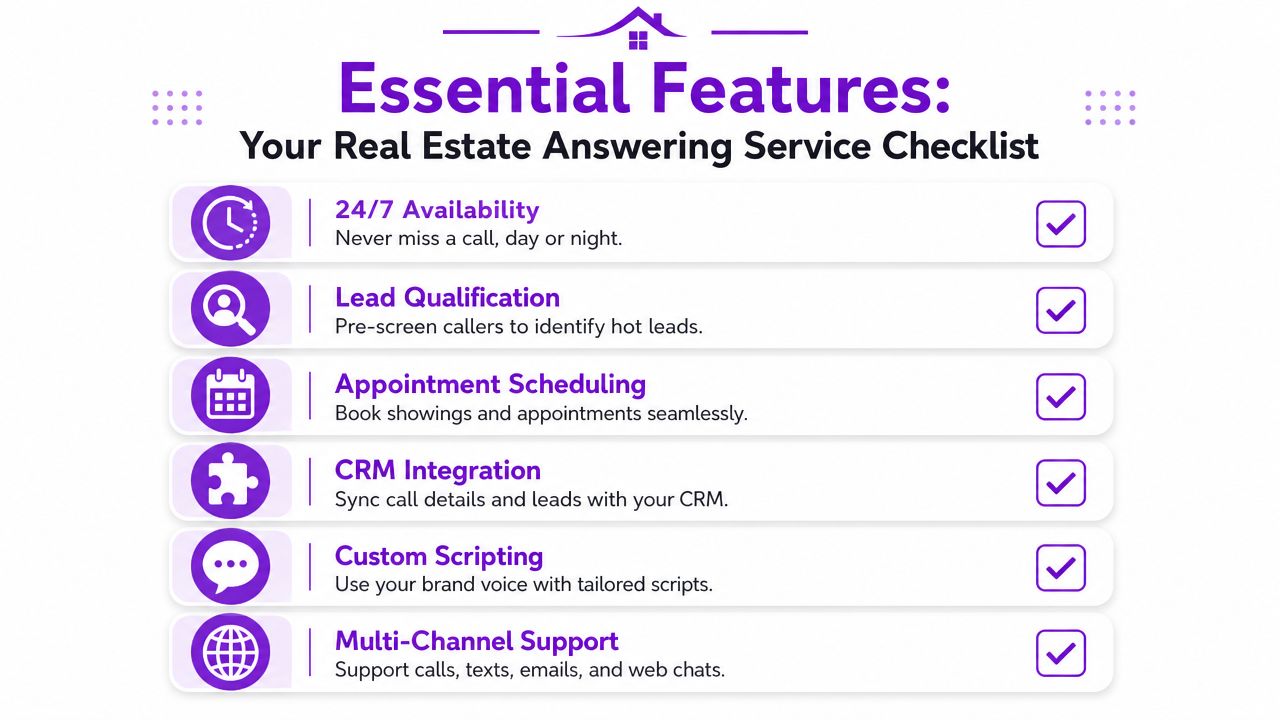
Always-on coverage
Real estate demand shows up at inconvenient times. Buyers call after work. Sellers call during your listing appointment with someone else. Tenants call when something breaks at night.
Coverage needs to match that reality. Look for a service that can answer after hours, follow rules for urgent calls, and transfer only the calls you want interrupted for. If the provider only covers a narrow window, you still end up carrying the risk during the hours when a lot of inbound interest happens.
Lead capture that gives you a usable handoff
The handoff matters more than the greeting.
A service should collect details that let you act fast without replaying the whole conversation in your head. For buyer calls, that usually means property address or MLS number, price range, financing status, timeline, and whether the caller is already represented. For seller calls, it means address, motivation, timeline, and whether they need to buy before they sell.
That is what turns a callback into a real follow-up instead of a second intake call.
A broker or team lead should also be able to shape the script by lead type. The questions for a first-time buyer are different from the questions for a maintenance request, leasing inquiry, or vendor call. If the service cannot handle those branching paths, your team will spend extra time cleaning up bad notes later.
Booking that reduces callback lag
If the caller is qualified and wants the next step, the service should help lock it in.
That can mean scheduling a showing, a buyer consult, a listing appointment, or a leasing follow-up based on your calendar rules. It can also mean sending a confirmation text, sharing the right prep details, and flagging the appointment type correctly inside your system so your team knows what kind of conversation is coming.
This is one of the clearest workflow wins because it cuts down on text tag, voicemail chains, and half-finished follow-up.
CRM and MLS visibility during the call
This feature starts paying off once your volume picks up.
According to Recepta’s breakdown of real estate answering service workflows, a technically advanced service should support CRM and MLS integration so the person handling the call can identify the listing in real time, reference current property details, and create or update the contact record with the right listing attached. That reduces manual lookup work and lowers the odds that a serious lead gets logged with vague notes.
Without that connection, your team ends up sorting through messages like “asked about the house on Maple with the blue door,” then trying to figure out which listing the caller meant. That is wasted time, and it slows follow-up on the calls with the highest intent.
Teams exploring adjacent tools often run into the same issue on the investment side, which is why resources on AI for real estate investing tend to focus on data flow and handoff quality, not just automation features.
Bilingual support and spam filtering
These features protect your time.
If a meaningful share of your market speaks Spanish, bilingual call handling removes friction at the first touchpoint. Spam screening matters for a different reason. It keeps robocalls, cold pitches, and junk inquiries from reaching your phone or clogging your CRM.
Use this checklist when comparing providers:
Language coverage: Confirm the service can handle the languages your market uses.
Spam screening: Block obvious noise before it reaches your team.
Custom call paths: Set different scripts for buyers, sellers, tenants, owners, and vendors.
Fast summaries: Get transcripts, recordings, or structured notes that make follow-up easy.
The right feature set is the one that fits your day. If it cannot qualify, book, route, and document a call in a way your team can use right away, it is still creating work instead of removing it.
Live agents vs AI vs hybrid models
A buyer calls at 8:17 p.m. about your new listing. You are in a showing, your assistant is off, and the caller hangs up after voicemail. That one moment is what this decision is really about. You need a call handling setup that fits the way your team works, not a generic answer service package.

Goodcall’s pricing comparison for real estate answering services reports AI-powered plans starting at $41 per month, hybrid plans from $95 per month, and live-only coverage from $325 per month. Some live services also add per-minute fees in the $1.40 to $3.39 range. For teams with uneven call volume, that pricing model can turn a busy weekend or a new listing launch into a bigger bill than expected.
Price matters, but workflow fit matters more.
Where live agents still make sense
Live agents work well for conversations that need judgment. Distressed sellers, upset tenants, luxury clients, and callers with messy situations usually respond better to a trained person who can slow things down, ask follow-up questions, and adjust tone in real time.
The trade-off is consistency. One operator gets the details right. Another misses the property address, logs thin notes, or goes off script. If your team relies on precise intake and fast follow-up, that variation shows up later in your CRM and your close rate.
Live-first coverage usually makes sense for teams that treat the answering service as an extension of inside sales, not just overflow reception.
Where AI fits a real estate workflow
AI does best with structured call paths. If you already know the questions that qualify a buyer, the seller signals that require a warm transfer, and the appointment slots your team wants filled first, AI can handle a large share of inbound calls with more consistency than many agencies expect.
That matters in real estate because speed alone is not enough. The service also has to capture the right facts in the right format so your agent can act on them. A strong setup collects property address, intent, timeline, representation status, and next step. It should also follow a clear real estate lead qualification workflow instead of dumping raw transcripts into your inbox.
Voice quality still matters. So does accuracy. If the system sounds awkward, mishears names, or fails to route urgent calls, callers notice immediately and your team ends up cleaning up the mess.
I usually recommend AI first for solo agents and smaller teams with repeatable call types, especially after-hours and weekend coverage.
If you’re also evaluating broader automation across acquisitions and follow-up, this guide to AI for real estate investing shows how operators are using similar systems beyond front-desk call handling.
When hybrid is the right middle ground
Hybrid models are often the practical choice because real estate calls are mixed. Half the day is simple intake, showing requests, and routing. The other half includes edge cases, escalations, and callers who need a person.
A hybrid setup lets AI handle the predictable parts, then passes exceptions to a human. That gives you lower cost than live-only coverage and better flexibility than AI alone. It also supports a cleaner handoff process. AI captures the basics, tags urgency, and sends the call to a live agent only when the conversation requires one.
That model works especially well for brokerages, property managers, and investor teams with changing volume.
Model | Best fit | Watch-out |
|---|---|---|
Live agents | High-stakes or emotionally complex calls | Higher cost, variable note quality |
AI | Structured intake, after-hours coverage, fast routing | Weak setup leads to poor caller experience |
Hybrid | Teams with mixed call types and fluctuating volume | Requires clear transfer rules and ownership |
The right choice comes down to how calls move through your day. If your goal is to stop missing inquiries, qualify them correctly, and hand them off without adding admin work, AI or hybrid usually gives the strongest return.
Sample scripts and call handoff workflows
At this point, a real estate answering service stops being abstract.
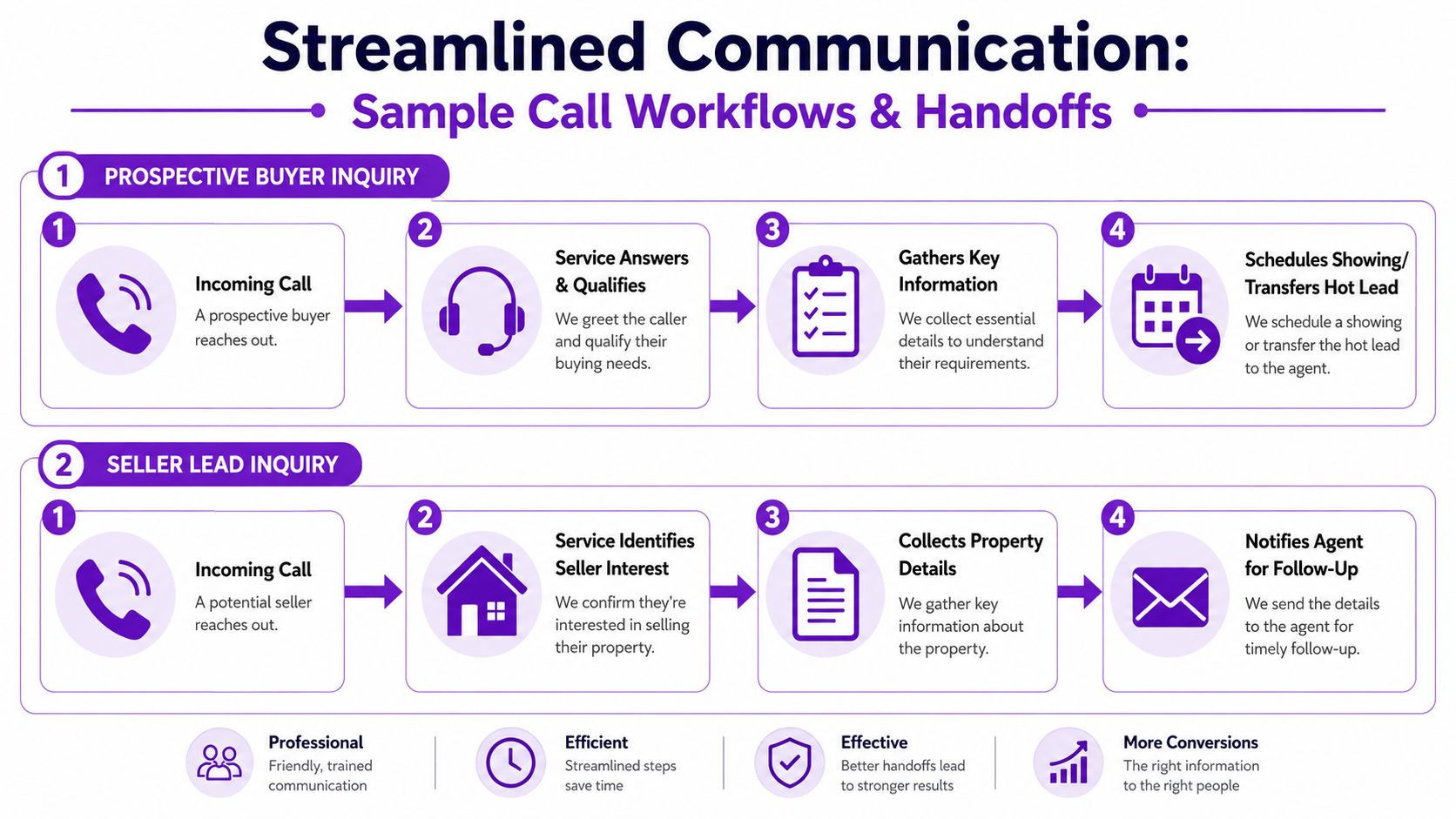
Buyer inquiry script
A buyer calls about one of your listings.
The service answers, confirms which property they mean, asks whether they’re looking to schedule a showing or just have a few questions, and captures the basics needed for a real follow-up.
A simple script might sound like this:
Opening: “Thanks for calling. Are you asking about a specific property or looking for help with your search?”
Property check: “Which address are you calling about?”
Intent: “Would you like to schedule a showing, or do you have questions about the property first?”
Fit questions: “Are you already working with an agent?” and “How soon are you hoping to move?”
Next step: Book the showing, transfer if it’s urgent, or send the lead summary to the agent
Seller lead script
Seller calls need a different flow.
You’re trying to understand whether this is a pricing-curious homeowner, a ready-to-list lead, or someone exploring options for later.
A useful script looks more like:
Reason for the call: “Are you thinking about selling a property?”
Property basics: “What’s the property address?”
Timeline: “Are you looking to sell soon, or just gathering information right now?”
Goal: “Are you also planning to buy after the sale?”
Follow-up path: Route to the agent, offer an appointment slot, or send a structured summary
If you want to tighten this process, this guide on real estate lead qualification is worth reading. The stronger your intake questions, the less time you waste chasing weak callbacks.
What the handoff to the agent should look like
The handoff is where a lot of systems fall apart.
You don’t want a vague message. You want the caller’s name, reason for calling, key details captured during the conversation, and a transcript or recording if you need context before calling back.
Dean Konstantine of McKnight described that value clearly:
“What we love most is how it captures every call and delivers both a full dialog transcript AND the actual recording straight to us. No more wondering what was said or missing important details. Everything is documented perfectly, every time. Our whole team is obsessed with this feature.”
That’s what turns a callback into a continuation instead of a restart.
Getting started and best practices
The first week determines whether your answering service becomes a lead-capture system or just another inbox.
Start small. Put it on after-hours and overflow calls first, then listen to what happens. That gives you a safer rollout and shows where callers get stuck before you trust the system with every inbound lead.
A practical setup usually starts with your public information. Feed in the basics from your website and Google Business Profile so the service can answer routine questions about office hours, service area, active listings, and how you handle showings. Then set actual operating rules: which callers should be transferred live, which ones should get booked, and which ones should be logged for callback. After that, forward your number and run test calls from a few common scenarios, such as a new seller lead, a tenant issue, and a buyer asking about a specific property.
Daniel Terner of Terner Elder Law, P.L. described that balance clearly:
“It can’t be easy to develop a product that is both super-configurable yet also easy to use, Rosie strikes this balance extremely well. My clients are happy and I’m happy, it’s a win/win.”
The setup itself is the easy part. The rules are what protect your time.
Real estate teams usually need the service to cover after-hours calls, overflow during busy blocks, basic lead screening, appointment booking, and urgent routing. If those rules are vague, the service will either send you too many interruptions or hold calls you should have taken live. Neither outcome helps conversion.
Use a few operating standards from day one:
Define hot transfers in plain language: Set exact triggers such as “seller ready to list in the next 30 days,” “buyer wants to see a property today,” or “active client with a contract issue.”
Build separate paths by caller type: Buyers, sellers, tenants, vendors, and existing clients need different questions, different urgency levels, and different follow-up.
Assign one owner for updates: One person should update FAQs, listing status, showing instructions, and office availability every week.
Review real call summaries: Look for missed appointment chances, repeated questions, and bad routing decisions. Those patterns usually point to a script problem, a stale knowledge base, or a weak website page.
Measure speed to follow-up: Track how quickly your team calls back qualified leads from the service. Fast intake matters, but fast follow-up closes the gap between inquiry and appointment.
One more best practice. Write the handoff rules before launch, not after the first missed opportunity.
For example, if a caller says they need to sell before buying, wants an agent recommendation, and has a likely three-month timeline, the service should tag that as a seller lead, capture the address, note the timeline, and send it to the right agent with the callback priority already set. That is where the ROI shows up. You save admin time, but the critical gain is that your team stops losing momentum between first contact and first real conversation.
If you are increasing top-of-funnel volume too, pair your phone process with stronger acquisition work. More calls only help if they are handled well, and these best real estate lead generation methods are a useful complement to a tighter answering workflow.
Stop juggling calls and start closing deals
You don’t need more phone anxiety.
You need a system that answers when you can’t, captures the right details, and keeps deals moving while you stay focused on showings, negotiations, and follow-up that requires you. That’s what a real estate answering service is for.
If you’re also working on the top of your funnel, this roundup of best real estate lead generation methods pairs well with a stronger call-handling process. More leads only help if somebody answers.
Frequently asked questions
Can AI really handle real estate calls without sounding stiff
It can, if you give it a narrow job and a clean setup.
In real estate, many inbound calls follow the same paths. A buyer wants price, availability, HOA details, or a showing. A seller wants a valuation, your process, or a listing appointment. AI handles those first-touch conversations well when it has your property details, your office rules, and a clear handoff path for anything nuanced.
Poor setup is what makes it sound robotic. Generic greetings, vague answers, and no escalation rules will frustrate callers fast. A good system should know when to answer, when to collect lead details, and when to put a hot prospect through to you right away.
How much does a real estate answering service cost
Cost depends on the coverage model, call volume, and how much screening you want before a lead reaches you.
Some agents need basic after-hours coverage. Others need full-time overflow handling, appointment booking, CRM notes, and urgent transfer rules. The monthly bill can look reasonable at first, then climb if you pay per minute or route too many low-value calls to a live team.
The better question is whether the service helps you capture, qualify, and route enough good opportunities to pay for itself. If it saves even one listing lead that would have gone to voicemail, the math can work out quickly.
Will callers know they’re not talking to a person
Sometimes yes. Often no. The bigger issue is whether the caller gets helped without friction.
Edgar Quinteros of The Copier Guy said, “The response with callers is so real, sometimes customers don’t know it’s AI.” That matters less than execution. In practice, callers care about getting a clear answer, leaving the right details, and knowing what happens next.
A stiff but accurate system will still lose trust. A natural-sounding system with bad routing will do the same. The goal is a call flow that feels competent and moves the lead forward.
What if I already have an in-house receptionist
Then use the service to cover the gaps, not duplicate the role.
For many brokerages, that means evenings, weekends, lunch breaks, overflow spikes, and the stretch when the receptionist is handling walk-ins or paperwork. It can also take repetitive work off the front desk, like spam filtering, basic inquiry capture, and standardized intake for new buyer or seller leads.
That setup usually works better than an all-or-nothing replacement. Your in-house person handles office context and relationship-heavy calls. The answering service handles volume, consistency, and coverage hours your team cannot reliably staff.
If you’re ready to stop missing calls and start capturing more buyer and seller leads, Rosie can answer your business calls, qualify prospects, book appointments, transfer priority calls, and keep your team updated with summaries, transcripts, and recordings.