You’re halfway through a job. Your hands are dirty, the ladder’s up, and your phone starts buzzing in your pocket for the third time in ten minutes. You let it ring because you have to finish what’s in front of you. Later, you check the voicemail. One was spam. One was a price shopper. One was a real customer who already booked with someone else.
That’s the everyday problem behind all the buzz around voice cloning technology.
For a small service business, this isn’t about shiny AI. It’s about whether your business can answer like a pro when you’re too busy to grab the phone. Done right, modern AI voice tools can help you sound responsive, helpful, and organized without chaining you to every call.
Here’s what you’ll get from this guide:
A plain-English explanation of how voice cloning technology works
A practical breakdown of where it helps local businesses most
A safe starting plan so you can use it without wandering into legal trouble
If you already know missed calls are costing you work, you can get started with Rosie here.
Table of Contents
The call you can’t take is your competitor’s next job
A plumbing leak doesn’t wait for office hours.
Neither does a locked-out homeowner, a hot house in July, or a buyer who wants to tour a listing before dinner. Local service businesses live in the gap between “I need help now” and “who answered first.”
That’s why the missed-call problem hurts so much. It rarely feels dramatic in the moment. It’s just one ring while you’re under a sink, one voicemail while you’re driving, one callback you mean to make after lunch. But stacked together, those little misses shape how people judge your business.
They don’t see that you were on a roof or handling a difficult customer.
They just know somebody didn’t answer.
The phone call is often the first job interview
When people call a local business, they’re not looking for a polished speech. They want basic proof that you’re responsive, legit, and easy to work with.
A good phone interaction answers simple questions fast:
Can you help me?
Do you serve my area?
What happens next?
Can I book something without chasing you down?
If your business can’t answer those in the moment, many callers move on.
Practical rule: A missed call isn’t just a missed conversation. It’s often a missed decision.
That’s where modern voice tools start to matter. Not as a gimmick, but as a way to make sure your business can still answer, qualify, and guide callers when you’re busy doing the actual work.
Why answering every call is a trap
Trying to answer every call yourself sounds responsible.
In practice, it can wreck your day.
The phone steals attention from the work that pays you
If you run an HVAC company, electrical shop, law office, auto repair business, or real estate team, your time is already split into pieces. You’re quoting jobs, handling crews, checking parts, answering customer questions, and fixing problems as they pop up.
Then the phone interrupts all of it.
You stop what you’re doing, wash up or step outside, answer, and find out it’s a robocall, a vendor pitch, or someone asking a question that could’ve been handled in seconds by a system with the right info.
That stop-and-start rhythm costs more than annoyance. It breaks focus, slows jobs down, and keeps the owner stuck as the switchboard.
Jason Aleman of Gutter Cowboy put it plainly: “It’s almost every day that I lost a job due to not answering the phone. Rosie can take all of those calls and handle them appropriately.”
That line hits because it’s familiar. A lot of local businesses aren’t losing work because they do bad work. They’re losing work because they can’t be in two places at once.
The old options are both bad
For years, the choices looked like this:
Option | What happens |
|---|---|
Answer every call yourself | You interrupt jobs and burn attention all day |
Let calls roll to voicemail | Good leads get cold fast |
Hire someone to answer | Helpful, but not always realistic for a small team |
That’s why this category has grown so quickly. One market estimate valued the global AI voice cloning market at USD 1.45 billion in 2022, USD 1.92 billion in 2023, and projected USD 9.75 billion by 2030 at a 26.1% CAGR, according to Grand View Research’s AI voice cloning market report.
You don’t need to be impressed by the market size.
What matters is what it signals. This stopped being a weird lab demo. Businesses are using AI voice tools because the phone problem is real, constant, and expensive in ways that don’t always show up neatly on a spreadsheet.
If you have to choose between doing the work and answering the phone, the business eventually feels smaller than it should.
How modern AI voices actually work
Voice cloning technology sounds futuristic, but the mechanics are pretty grounded.
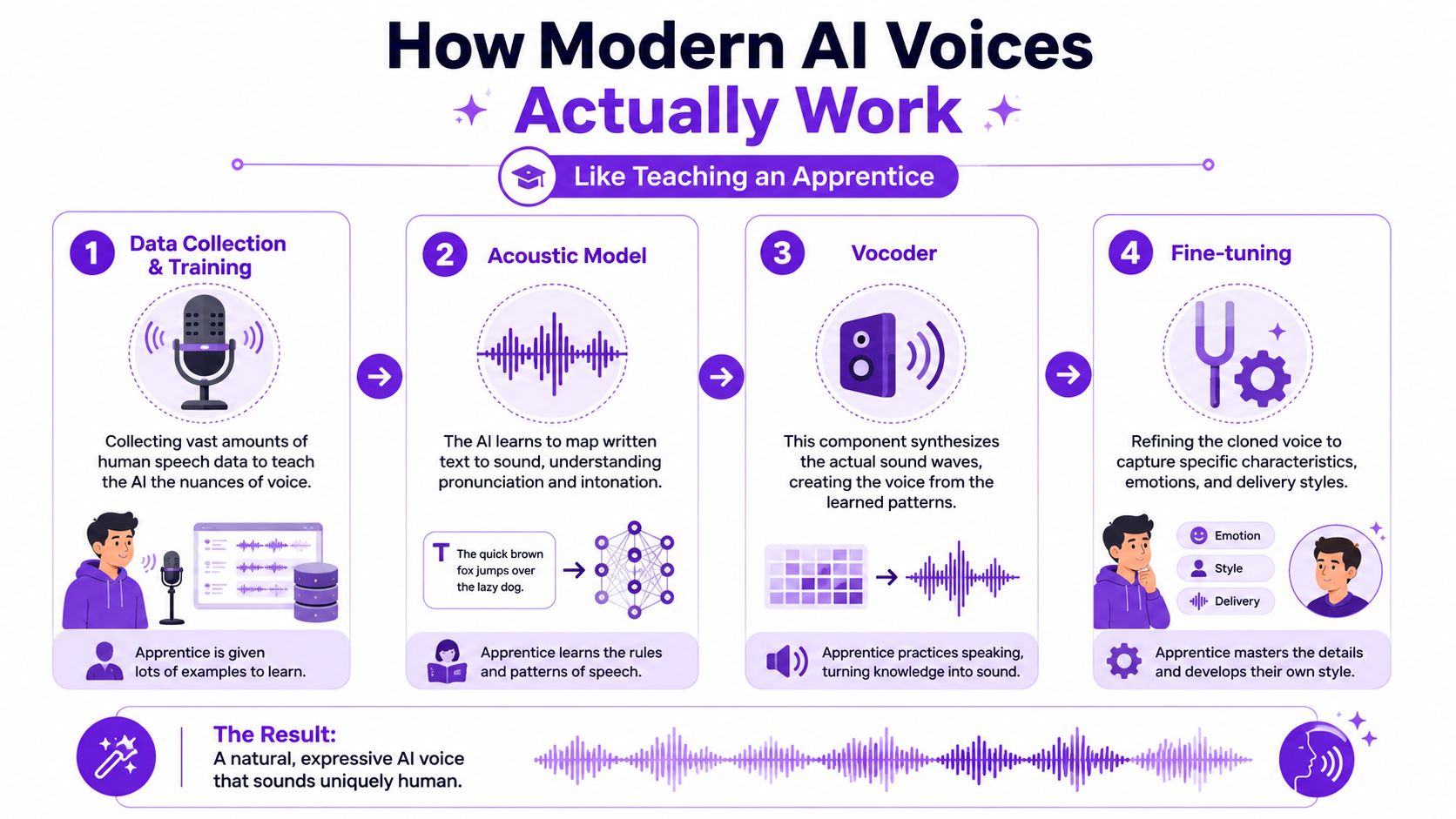
An AI voice system learns from recordings much the way a new front-desk hire learns from listening to your best office manager. It picks up pronunciation, rhythm, tone, and the little habits that make a voice sound familiar to callers.
How the training process works
The system starts with audio samples.
From those recordings, the model studies patterns such as pitch, timbre, pacing, accent, and inflection. Then it uses those patterns to generate new speech in that voice, instead of replaying old clips word for word, as explained in RWS’s overview of voice cloning.
That part trips people up, so here is the plain-English version. Good voice AI is not a soundboard full of canned lines. It is closer to a musician who has learned the style well enough to play a new song in the same voice.
For a small service business, that distinction matters. If a caller asks, “Do you service my neighborhood and can you come Friday morning?”, the system needs to answer a question it may never have heard in that exact wording before.
Why one AI voice sounds polished and another sounds off
The recordings you start with shape the result.
Clear, consistent audio gives the model a better example to learn from. Background noise, muffled phone audio, or clips recorded in different environments can make the voice sound stiff, uneven, or strangely robotic.
That is why some systems feel trustworthy on a call and others sound like they are reading from a script underwater.
Ford Wright of Pacific Power Washers described the weak version well: “We have tried other AI receptionists, but they sounded robotic and worse, misspelled contact info, making it worthless.”
Edgar Quinteros of The Copier Guy saw the other side: “The response with callers is so real, sometimes customers don’t know it’s AI.”
Those two outcomes come from the same category of tool, but not the same level of setup, training data, or product design.
Fast clones, better-trained voices, and what that means for your phones
Not every voice system is built the same way.
Some tools can produce a convincing voice from a very small sample. A University of Tennessee voice cloning security briefing notes that attackers can build persuasive replicas from just a few minutes of recorded audio, and in some cases from only seconds. More heavily trained systems use more examples and usually hold up better across longer conversations.
Here is the practical breakdown:
Low-data or instant cloning: quick to set up, but more likely to sound inconsistent
Few-shot cloning: trained on more examples, which usually improves stability
Fine-tuned voice systems: take more preparation, but tend to sound more natural across real calls
If you run a plumbing shop, HVAC company, med spa, or roofing business, that difference is not academic. A voice that handles one demo sentence well is not enough. You need one that can confirm service areas, answer common questions, collect names and numbers accurately, and stay clear when a caller is stressed or in a hurry.
That is also why tools around the voice matter as much as the voice itself. The speech layer is only one part of the job. The system also needs good call logic, lead capture, routing, and guardrails. You can see more examples in these AI and automation articles for small businesses.
If you create ads and want the spoken message to match the speed and polish of your call handling, the ShortGenius AI ad generator is one example of how businesses are using AI voice tools outside the phone line too.
Good voice AI earns trust the same way a good receptionist does. It sounds consistent, listens well, and helps the caller get to the next step without friction.
Putting an AI voice to work for your business
The technical side is interesting.
The day-to-day business side is what matters.
What this looks like on a normal Tuesday
A caller reaches out at 9 PM because their AC quit.
Another wants to know if you service their zip code.
A third asks whether you handle emergency work, and a fourth wants pricing before they commit to a visit. None of those calls require you to stop dinner, step out of your kid’s game, or pull over on the highway if the system can answer clearly and guide the person to the next step.
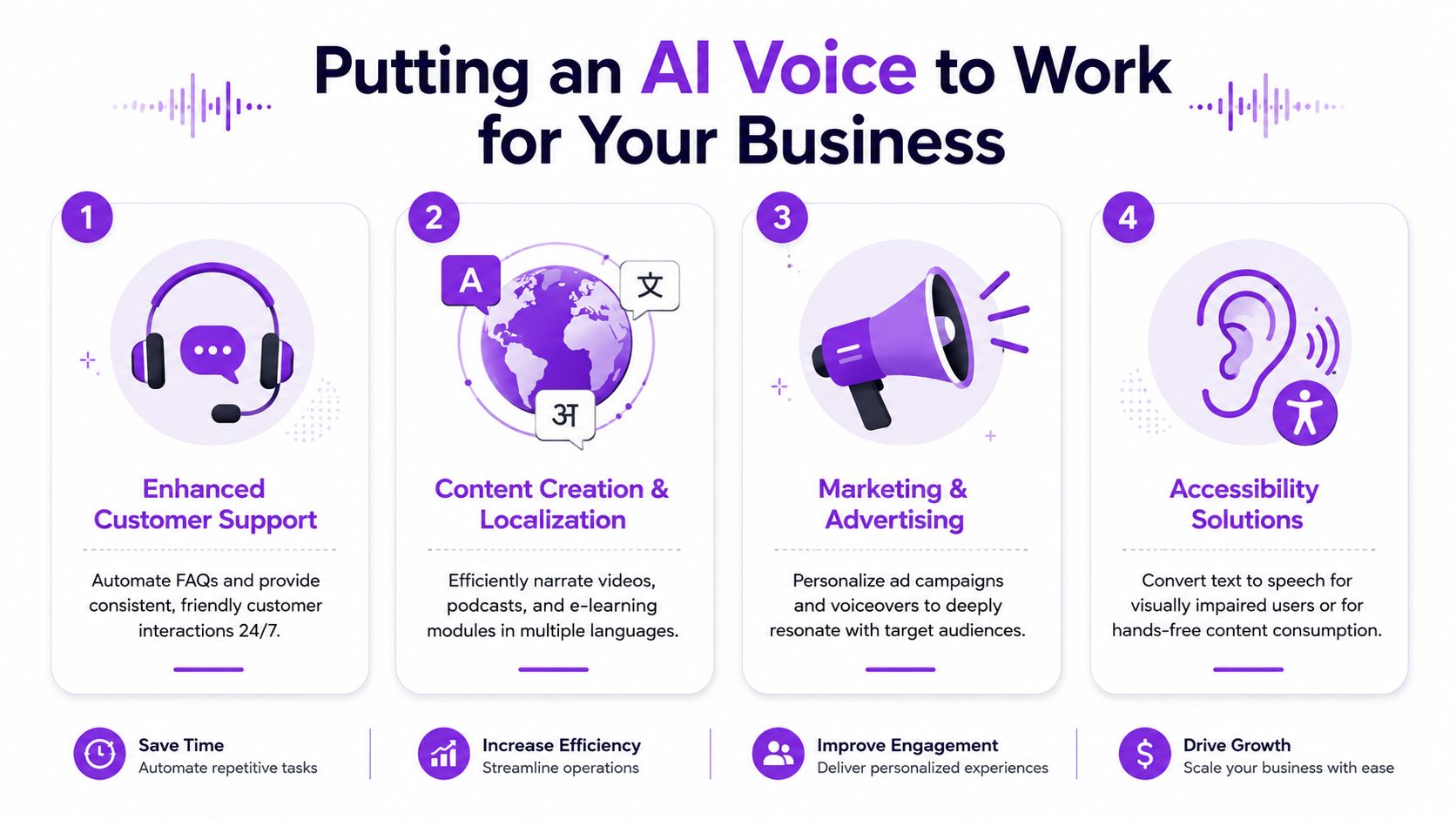
For a local business, useful AI voice work usually looks like this:
Lead capture after hours: The call still gets answered when your team is off
FAQ handling: Hours, service areas, common pricing questions, and policies get handled right away
Appointment booking: Qualified callers can move into scheduling instead of voicemail tag
Call routing: Urgent calls can go to a real person while routine ones stay automated
Bilingual help: English and Spanish callers can get information without friction
That’s why tools built for this job matter more than generic voice demos. A serious AI receptionist for small businesses isn’t just there to sound human. It needs to answer accurately, qualify real leads, and move the call forward.
This is more than message taking
A lot of owners hear “AI phone assistant” and picture a digital sticky note.
That’s too small.
Derek Goodson, Founder of Next-Level Marketing Agency, described the difference well: “She doesn’t just take a name and number, she asks the right questions about what services they need… By the time I call them back, I already know exactly what they’re looking for and can jump straight into offering solutions instead of spending 10 minutes on discovery.”
That changes the callback completely.
Instead of returning a cold voicemail and hoping the person still answers, you’re stepping into a warmer conversation with context. You already know what they need, what kind of job it is, and where to take it next.
Jason Aleman described the customer side of that experience too: “People tell me all the time, you’re really easy to do business with. I called, I got the link sent to me, the pricing was there, I booked an appointment and you showed up to the job.”
That phrase matters more than it seems.
Easy to do business with wins a lot of local deals.
Where voice fits beyond the phone
Phone coverage is the clearest use case for a service business, but voice tools can do more. Some shops use them for follow-up content, short explainers, or ads where a natural voice matters.
If you’re experimenting with audio and video at the same time, a tool like ShortGenius AI ad generator can be a useful companion for turning marketing ideas into quick ad creative without dragging your team into a full production project.
The practical takeaway is simple. Voice isn’t valuable because it sounds futuristic. It’s valuable because it helps customers get answers and take action while you keep the business moving.
The risks and how to stay on the right side of the law
This is the part people should take seriously.
Voice tools can help good businesses. They can also be misused.
The real risk is not the technology itself
The biggest concern isn’t that a business uses AI voice.
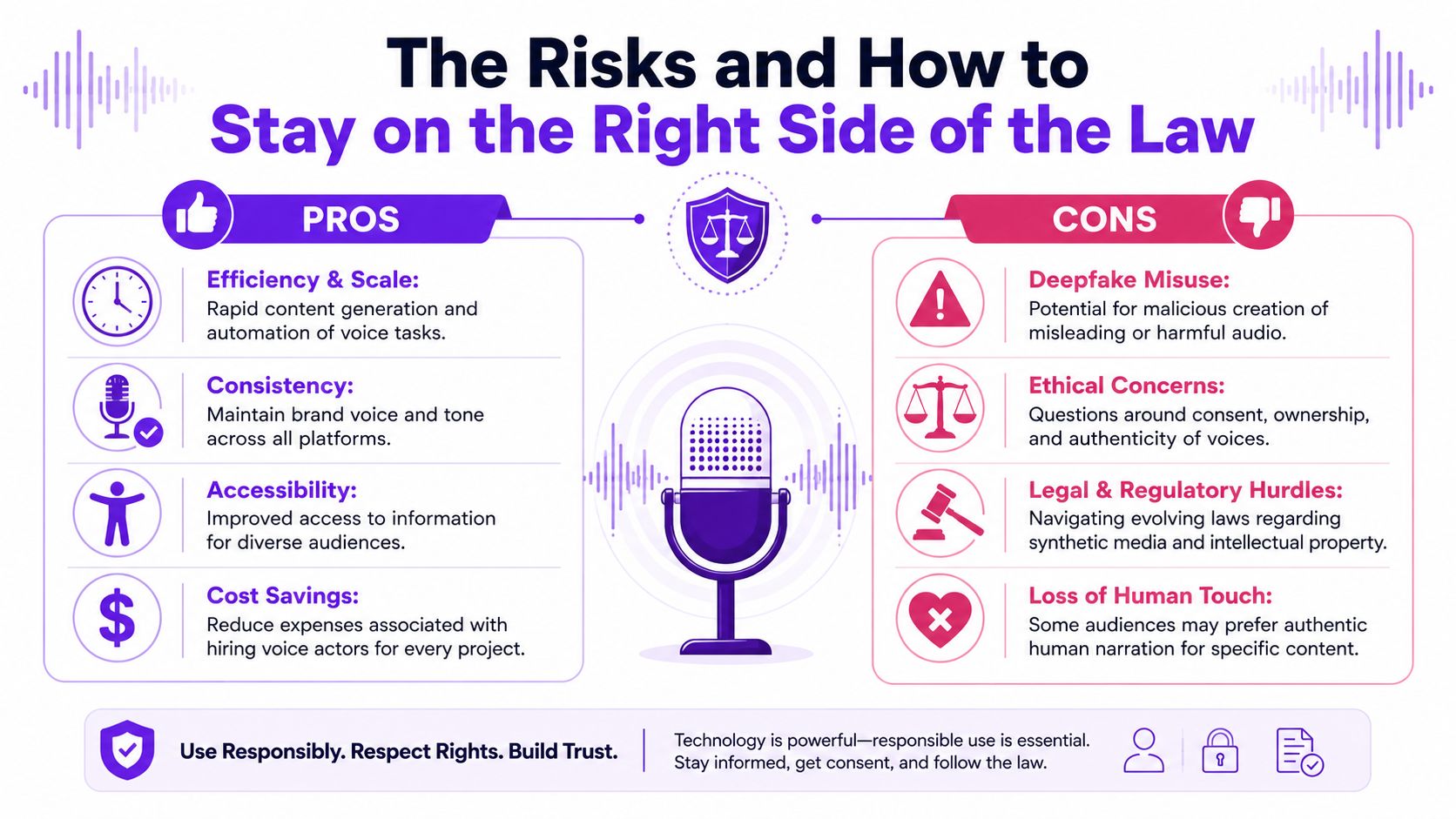
It’s whether the business has the right to use that voice, whether callers are being misled, and whether the system is being run with basic safeguards.
The FTC has highlighted a major gap here: how to verify consent and ownership when a voice is cloned, and it notes that these systems are generally trained on real voices and can be easy to access. That’s why using a provider that handles compliance matters more than downloading random open-source tools from the internet. You can read the FTC’s discussion in its post on preventing harms from AI-enabled voice cloning.
For a small business owner, that turns into practical questions:
Question | Why it matters |
|---|---|
Do I have permission to use this voice? | Consent and ownership are the foundation |
Am I clear that callers are interacting with AI? | Transparency reduces confusion and risk |
Is sensitive call data being handled responsibly? | Calls often contain personal details |
Can I document what the system said and did? | Records matter when disputes happen |
If you want a broader consumer-facing explanation of how people try to spot synthetic audio, this overview from AI Video Detector’s blog is a useful reference point.
What good governance looks like in plain English
You don’t need a legal department to be responsible.
You do need a few habits.
Use voices with permission: Don’t clone a person’s voice unless you’re authorized to do it
Disclose clearly: Let callers know they’re speaking with an AI assistant
Keep records: Save transcripts, summaries, and recordings when appropriate
Review outputs: Make sure the system answers in a way that matches your policies
Choose providers carefully: Look for clear documentation around data handling, such as Rosie’s data processing information
Bottom line: If a tool makes it easy to create a voice, that does not mean it makes your use of that voice legal or wise.
Responsible use is not just about avoiding trouble. It also protects trust. Customers don’t mind smart systems nearly as much as they mind confusion, deception, or sloppy handling of their information.
Your simple plan for getting started safely
A good rollout doesn’t start with the voice.
It starts with the job you need the system to do.
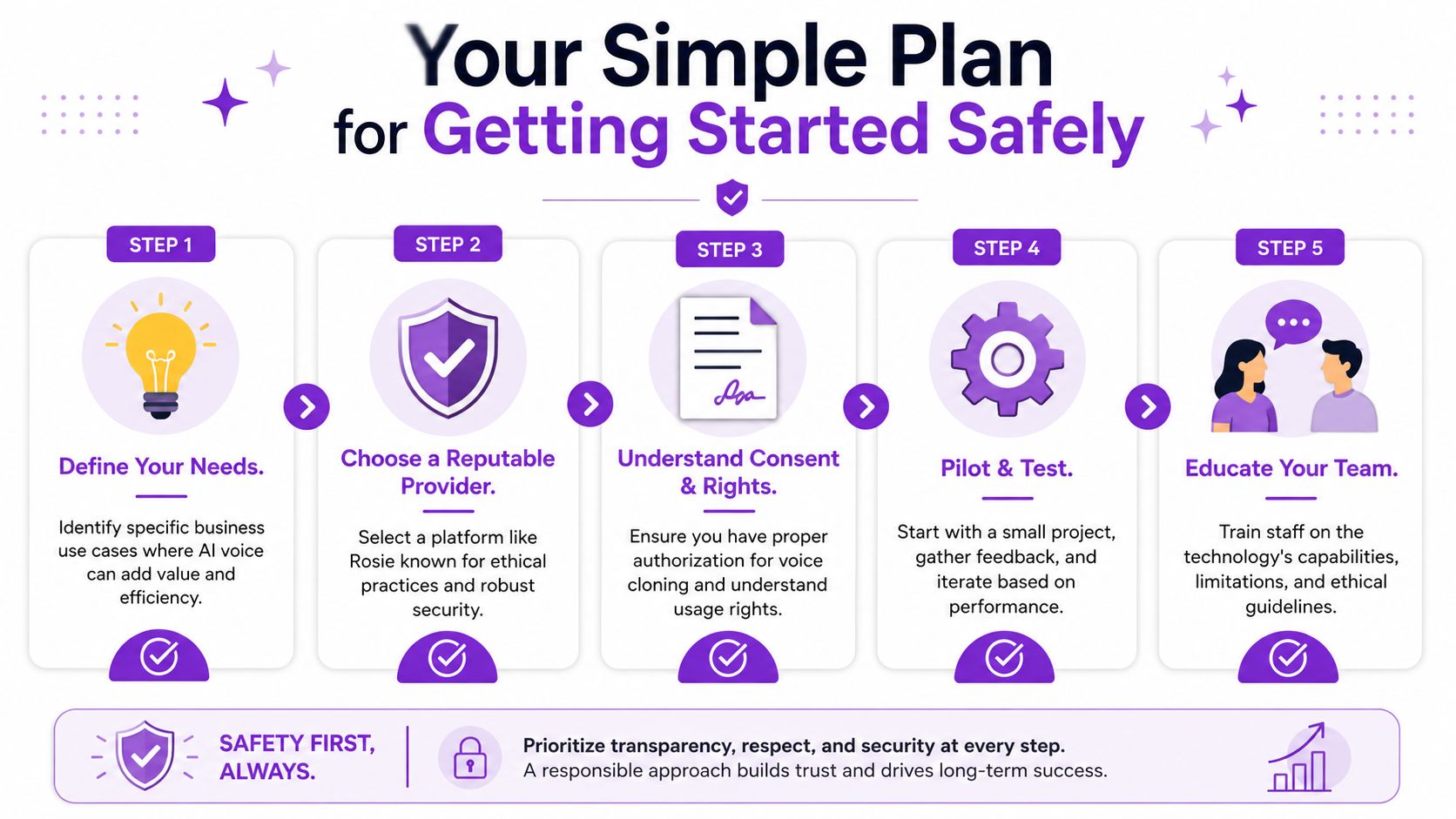
Start with the job to be done
Pick one or two problems that waste time every week.
Maybe it’s after-hours calls. Maybe it’s spam. Maybe it’s the same pricing and service-area questions over and over. Keep it concrete. “Answer every call” is too broad. “Handle missed calls from new leads and book qualified appointments” is clear.
That gives you a better way to judge whether the setup is working.
Build from your real business information
The smartest systems don’t need a giant IT project.
They need your actual business details. That usually means letting the platform scan your website or Google Business Profile, then tightening things up with custom FAQs, pricing guidance, service-area rules, transfer logic, and booking instructions.
Daniel Terner of Terner Elder Law, P.L. said it well: “It can’t be easy to develop a product that is both super-configurable yet also easy to use, Rosie strikes this balance extremely well.”
A practical setup checklist looks like this:
List your common call types: New lead, existing customer, vendor, spam, emergency
Write your must-answer questions: Hours, services, areas served, pricing basics, policies
Choose your voice carefully: Friendly and clear beats flashy
Decide when to transfer: Define what counts as urgent or high-value
Turn on notifications: Make sure your team sees summaries fast
Test it like a customer would
Call your own number.
Have a friend ask weird questions. Try it after hours. Try a rushed caller. Try someone who wants to book right away. Then tighten the answers where the system sounds too vague or too stiff.
Daniel Oehl of Snap Fitness said, “I have had multiple people call in to test Rosie and they all think she is much better than a real receptionist.”
That kind of result doesn’t come from hoping.
It comes from testing, tuning, and making sure the system reflects how your business operates.
Stop missing calls and start growing your business
When your phone rings, that caller isn’t thinking about AI.
They’re thinking about whether someone can help them right now. Voice cloning technology matters because it helps a small business stay available, sound professional, and move work forward even when the owner is busy doing the job.
Frequently asked questions
Is voice cloning technology the same as a robot voicemail system
A robot voicemail system is closer to a digital answering machine. It plays the same prompts every time and waits for a message.
Voice cloning technology can handle a real conversation. It can answer common questions, sort out spam from real jobs, qualify a lead, and point the caller to the right next step. For a small service business, that matters because a plumbing emergency and a sales call should not go down the same path.
How much audio does it take to create a voice clone
That depends on the tool and the result you want.
Some systems can build a usable voice from a very short sample. Others need several minutes of clean audio to sound more consistent. A quick sample may be enough if your goal is a friendly, familiar phone voice. If you want the voice to hold up across longer conversations, cleaner recordings and more training material usually help.
Can customers tell they’re talking to AI
Sometimes they can. Sometimes they cannot.
The bigger issue is usually not whether they guessed it was AI. It is whether the call felt helpful, clear, and respectful. If the system sounds natural, answers the question, and gets the caller where they need to go, many customers care far more about speed than the technology behind it.
What should a small business worry about legally
Focus on four things. Consent, ownership, disclosure, and data handling.
Use a voice you have permission to use. Tell callers when they are speaking with AI if that applies in your area or use case. Choose a provider that explains how call data is stored and protected. Keep your business details accurate too, because good AI still needs the right hours, services, service area, and booking rules to avoid creating problems.
If you’re ready to stop losing jobs to missed calls, Rosie gives your business a voice that answers, qualifies leads, books appointments, and keeps your team focused on the work that pays.