Your tech is in one hand, a tool bag is in the other, and your phone starts buzzing while you’re halfway through a job. You let it ring because you have to. By the time you call back, the lead has already moved on.
That’s the problem behind virtual assistant service packages. You’re not just buying help. You’re trying to stop good opportunities from leaking out while you work.
A smart package can absolutely take admin work off your plate. But if your business lives and dies by fast call response, not every package is built for that job.
In this guide, you’ll learn:
How virtual assistant service packages are usually priced, and what those price ranges mean
How to choose a package based on your kind of business, not generic VA advice
Where traditional VA packages help, where they fall short, and what to use when calls can’t wait
If you’re still sorting out the difference between a VA and a front-line phone solution, this quick guide on what a virtual receptionist does will help. If you already know missed calls are costing you, you can create an account and test a better setup.
Table of Contents
The real cost of being spread too thin

A lot of owners treat missed calls like a minor annoyance. They’re not. They’re usually a sign that the business has outgrown the owner’s personal bandwidth.
Jason Aleman from Gutter Cowboy put it plainly: “It’s almost every day that I lost a job due to not answering the phone. Rosie can take all of those calls and handle them appropriately.” That’s the kind of sentence that should make any service business stop and think.
Missed calls rarely stay a small problem
One missed call means one maybe-lost lead.
A pattern of missed calls means your schedule gets less predictable, your pipeline gets weaker, and your team spends more time chasing people back instead of booking work cleanly the first time.
Then the second-order problems show up:
Burnout: You’re doing field work, callbacks, scheduling, and follow-up after hours.
Slower response: New callers wait too long and move to a competitor.
Messy intake: Details get scribbled on notes, buried in texts, or forgotten.
Reputation drag: People start to think you’re hard to reach.
That last one matters more than owners think. Customers don’t separate “busy” from “unresponsive.” They just remember whether someone answered.
Practical rule: If the phone is your front door, missed calls are not an admin problem. They’re a sales problem.
Why owners start looking at outside help
That’s why virtual assistant service packages have become so common. This is no longer a niche category. The virtual assistant services market is projected at USD 19.5 billion in 2025 and USD 55.4 billion by 2035, with an 11.0% CAGR over that period, according to Future Market Insights on the virtual assistant services market.
That growth makes sense. Owners want recurring help they can budget for instead of constantly patching holes.
The catch is simple. A lot of package models were built around scheduled admin work, not urgent lead capture. They’re useful for inboxes, calendars, follow-up tasks, CRM cleanup, and recurring office support. They’re not automatically the right fix for high-intent phone calls that come in while you’re under a sink, on a ladder, in court, or showing a property.
So yes, hiring help is the right instinct.
But buying the wrong type of help just gives you a cleaner version of the same bottleneck.
Understanding typical virtual assistant service packages
Virtual assistant service packages are usually sold in one of two ways. You either pay by the hour, or you buy a block of support every month.
Hourly pricing is straightforward. Retainer packages are easier to budget because you know what you’re buying before the month starts.
How packages are usually sold
Industry pricing guides commonly put monthly retainer-style packages around $500 to $2,500+, while U.S.-based virtual assistants are often priced around $20 to $75 per hour, with some specialized work reaching higher rates, as outlined in this virtual assistant pricing guide.
That range tells you something important. “VA package” is not one thing.
It can mean basic admin support from an individual freelancer. It can also mean an agency-run package with tighter process, backup coverage, bilingual support, or a more specialized task mix. If you want a side-by-side of front-desk style options, the Rosie pricing page is a useful benchmark for comparing fixed monthly support against other call-handling setups.
Typical virtual assistant package tiers
Most package offers fall into three broad capacity bands.
Package Tier | Typical Monthly Hours | Estimated Monthly Cost | Best For |
|---|---|---|---|
Starter | 60-80 hours | $1,500-$3,000 per month | Owners who need recurring help with inboxes, scheduling, and routine admin |
Professional | 120-160 hours | $3,000-$6,000 per month | Growing businesses with steadier task volume and ongoing support needs |
Premium | 160-240+ hours | $6,000-$12,000+ per month | Teams that need broad coverage, more process, and heavier recurring workload |
Those package ranges come from this breakdown of virtual assistant pricing packages and tier structures, which also notes that providers often report 15%-25% savings versus hourly billing when the package bundles admin overhead and related support.
Here’s how that plays out in practice.
A starter package usually works when the work is repetitive and predictable. Think inbox cleanup, calendar management, quote follow-up, simple CRM updates, or posting scheduled content.
A professional package makes more sense when one person is constantly feeding tasks into the queue: businesses start assigning follow-up, appointment coordination, vendor communication, reporting, and customer updates every week.
A premium package is closer to outsourced operational support. It’s for businesses that have enough moving pieces that someone needs to stay on top of a larger task stack every day.
Buying too small creates frustration. Buying too big creates waste. Good package selection is mostly about matching recurring workload to a realistic monthly capacity.
What package pricing is really buying you
A package is not just hours. It’s predictability.
You’re paying for reserved capacity, repeatable workflows, and less administrative friction than pure hourly billing. That matters when the tasks are clearly defined.
It matters less when your needs are erratic, urgent, or dependent on real-time coverage.
A lot of buyers get tripped up here. They assume that because a VA can answer some customer emails or return some calls, a virtual assistant service package will naturally solve live inbound phone demand. Sometimes it helps. Sometimes it absolutely doesn’t.
If the work can wait in a queue, packages work well.
If the work rings and disappears, you need to be more careful.
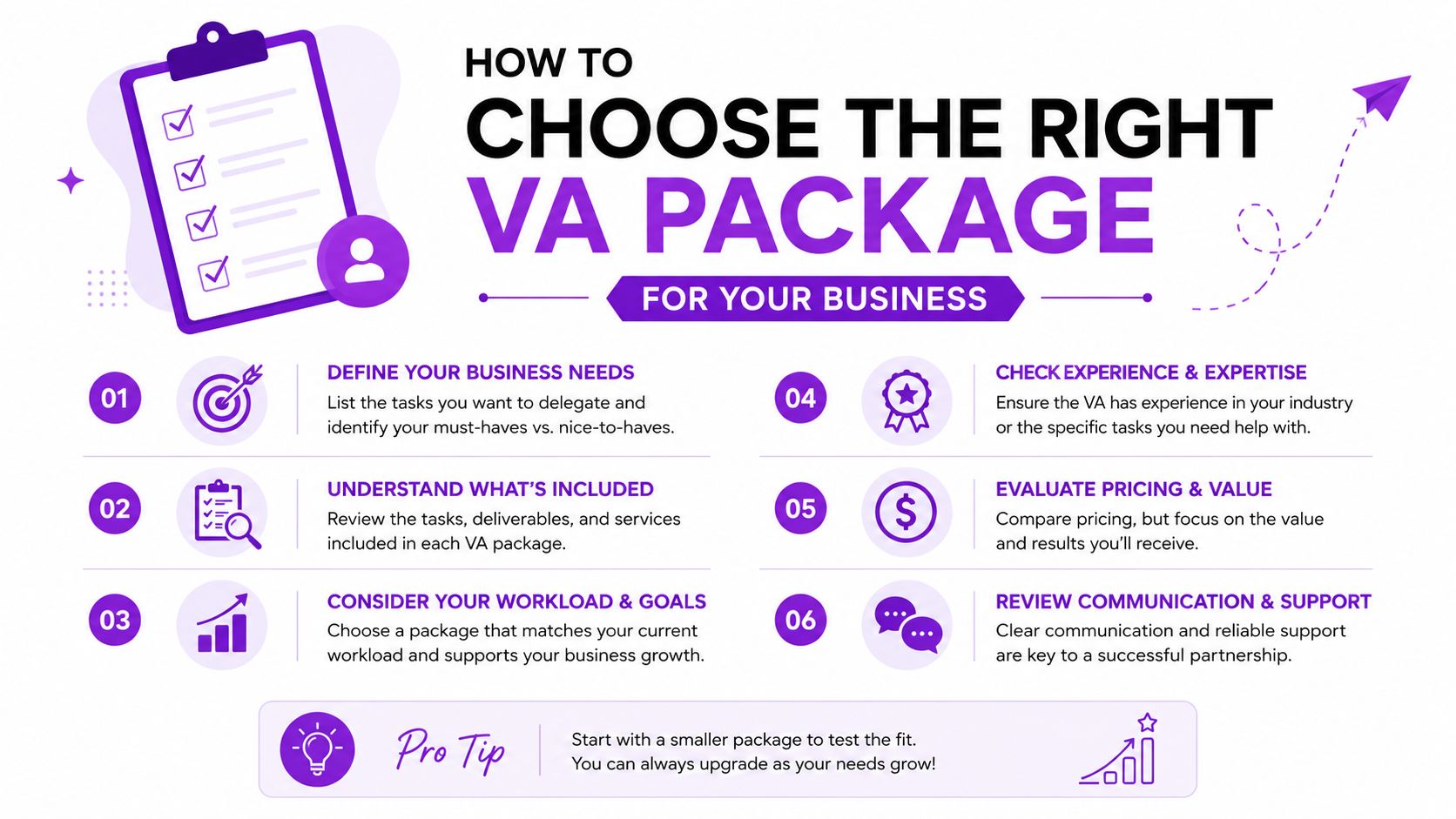
How to choose the right va package for your business
The right package depends less on industry labels and more on workflow. You want to look at what arrives repeatedly, what can be standardized, and what absolutely cannot wait.
One useful pricing reality to remember is that VAs often build packages from expected task time plus a buffer for communication and overhead. A task that takes a client 2 hours may take the assistant 2.5-3 hours, which is why clear, repeatable deliverables usually price better as packages than as pure hourly work, according to The Virtual Savvy’s explanation of package pricing.
Home services need speed first
For plumbers, HVAC companies, electricians, roofers, and cleaners, the first question is simple. Does this package help you answer and qualify inbound work fast enough?
If the package is centered on admin backlog, it won’t fix the actual leak.
For home services, good outsourced support usually covers:
Lead intake: Name, service type, location, urgency, and preferred appointment window
Scheduling support: Confirming booked jobs, reschedules, and reminders
Follow-up admin: Estimates, unpaid invoices, review requests, and job notes
What doesn’t work is paying a premium for a VA package when the VA is still operating in normal office blocks and your best leads call while you’re in the field.
Salons and spas need booking discipline
Salons, med spas, massage studios, and personal care businesses often have a different problem. Their front desk gets interrupted all day.
The best package here usually isn’t the one with the most hours. It’s the one with the clearest booking rules. If your assistant can’t answer basic service questions, route requests correctly, and keep calendars clean, you’ll still spend your day fixing mistakes.
A strong fit includes appointment coordination, confirmation follow-ups, waitlist handling, and policy messaging around cancellations or timing.
A weak fit looks like “general admin help” with no real booking system discipline.
Law firms need judgment and clean intake
Law offices need a tighter hand on intake. You don’t want vague message-taking. You want consistent capture of the right details, proper routing, and clean records.
Daniel Terner of Terner Elder Law, P.L. said, “It can’t be easy to develop a product that is both super-configurable yet also easy to use, Rosie strikes this balance extremely well. My clients are happy and I’m happy, it’s a win/win.”
That quote points to the standard. Legal intake support has to be configurable. Your process matters.
When you evaluate a VA package for a law practice, check for:
Structured intake: Can they collect the same screening details every time?
Escalation rules: Do urgent or sensitive matters go to the right person fast?
Documentation: Will your team have a clean record of what the caller said?
If you’re also reviewing your broader vendors, this guide to strategic agency selection for Fort Myers businesses is useful because the same buying discipline applies here too. Clear scope, process fit, and accountability beat flashy sales language.
Real estate needs responsiveness without chaos
Realtors, brokers, and property managers live with a constant stream of inquiries. Listing questions, showing requests, tenant issues, owner updates, vendor coordination, and spam all hit the same phone line.
That means you need two filters. One for urgency, one for relevance.
A package works well when someone is managing follow-up, updating records, confirming appointments, and keeping communication organized. It works badly when every incoming call still depends on a single person being free at that exact moment.
The right package doesn’t just remove tasks. It removes decision fatigue.
Before you sign anything, ask three direct questions:
What tasks are included every month, in plain English?
What happens when the monthly workload spills over?
Who handles inbound calls when nobody on my team can pick up?
If the answer to the third question is fuzzy, you haven’t solved the core problem yet.
The modern alternative for 24/7 call handling
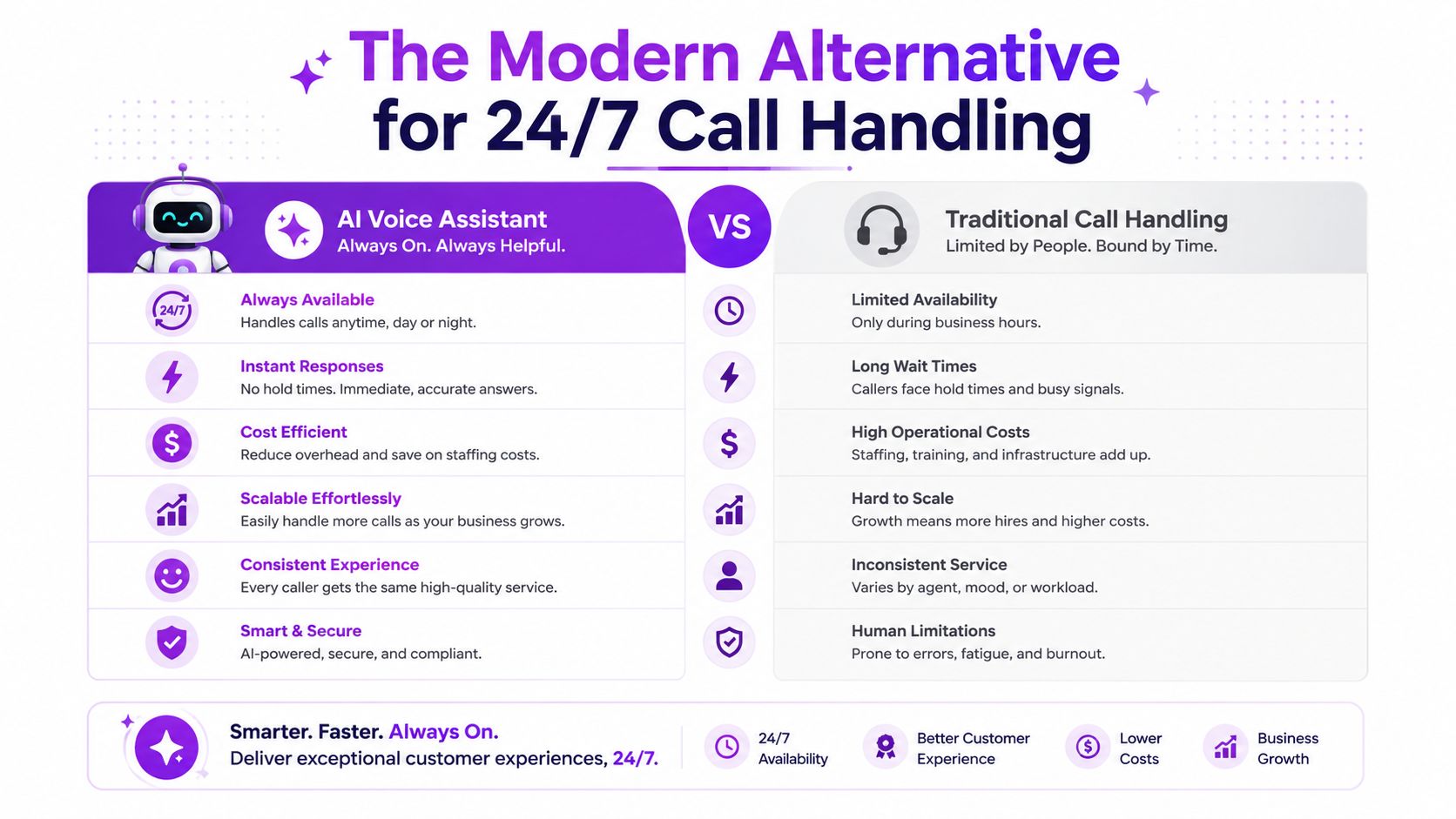
Traditional virtual assistant service packages can do a lot of good work. They’re strong when the job is organized, recurring, and not tied to instant response.
Phone coverage is different.
Where traditional VA packages do well
A human VA is often a great fit for things like:
Inbox and calendar work
Follow-up on estimates or paperwork
CRM updates and data cleanup
Recurring back-office tasks
Customer service that can be handled in batches
That’s solid support. No knock on it.
For many businesses, a VA should stay in the mix because there’s still plenty of work that benefits from human judgment, nuance, and relationship management.
Where they break down on live calls
The gap shows up when the call itself is the moment that matters.
Industry guidance notes that VAs are commonly used for admin, follow-up, and basic customer service, but businesses needing 24/7 call coverage and immediate lead qualification run into a different problem because traditional package models are built around block hours, not always-on availability, as explained in this guide on virtual assistants and call coverage limits.
That distinction matters a lot for service businesses.
A caller with a burst pipe, a locked-up AC system, or an urgent legal question usually doesn’t want a voicemail and a callback tomorrow. They want someone to answer, ask the right questions, and move them forward now.
Derek Goodson from Next-Level Marketing Agency said, “She doesn’t just take a name and number, she asks the right questions about what services they need… By the time I call them back, I already know exactly what they’re looking for and can jump straight into offering solutions instead of spending 10 minutes on discovery.”
He also put the availability issue even more plainly: “She doesn’t take any breaks, she doesn’t go on vacation, she doesn’t punch out at 5 o’clock.”
That’s the difference between task support and front-line coverage.
How an AI answering service fits
If your biggest pain is missed calls, the cleaner model is usually to split the job.
Use a human VA for the work that benefits from follow-through, exceptions, and relationship context. Use an AI answering layer for the calls that need immediate pickup, qualification, booking, transfer, and spam filtering.
One option is Rosie’s AI receptionist, which answers calls, uses your business information to respond to common questions, qualifies leads, books appointments, and transfers priority calls. Rosie scans your website or Google Business Profile, and it can be refined with FAQs and custom scenarios, so callers get something more useful than a generic message service.
That distinction matters because Rosie is not a message-taking service.
It’s built for front-line call handling. That means it can sort spam, capture lead details, answer routine questions, and hand off opportunities cleanly. For a shop owner, that’s often the missing piece a standard package never really covered.
Francisco Fierro of Iron Volt Electric said, “Before Rosie, missed calls meant missed jobs. When the crew is out in the field all day, no one can stop to answer the phone… Now I don’t have to stress about missed calls. Rosie picks up automatically so every caller gets a response even when we’re tied up on a job.”
So the trade-off is pretty straightforward:
Need | Traditional VA package | AI answering service |
|---|---|---|
Recurring admin tasks | Strong fit | Limited fit |
Real-time call pickup | Often limited by hours | Strong fit |
Immediate lead qualification | Inconsistent | Strong fit |
Appointment capture | Possible, depends on workflow | Strong fit |
Spam filtering | Usually manual | Built for it |
After-hours response | Expensive to extend | Native use case |
If your phone is where money enters the business, always-on response should not be buried inside a general admin package.
Get started with smarter call handling today
It’s 4:47 p.m. Your crew is still in the field, the front desk is tied up, and the next inbound call is probably a real buyer who wants an answer before calling the next company on the list. That’s the moment where a standard VA package often stops being enough.
If your problem is missed revenue from inbound calls, treat call handling like a sales process, not a side task.
Jason Aleman from Gutter Cowboy said, “People tell me all the time, you’re really easy to do business with. I called, I got the link sent to me, the pricing was there, I booked an appointment and you showed up to the job.”
That’s what callers remember. Fast response. Clear next steps. No friction.
What to do next
Audit your calls for one week. Write down which ones needed a human right away, which ones could have been handled automatically, and which ones should never have reached your team in the first place.
Then pressure-test your current setup against real call flow. Can it answer after hours? Can it qualify leads before they hit your calendar? Can it route urgent issues without making good prospects wait? If you want a cleaner way to review performance after setup, these effective call monitoring strategies are useful.
For many small businesses, the right answer is a split model. Use a VA for repeat admin work. Use an AI answering service like Rosie for the high-intent, time-sensitive calls that need instant pickup, basic qualification, and accurate booking. That usually closes the gap without adding the cost and scheduling limits of more live coverage.
If your current phone process depends on callbacks and crossed fingers, fix that first. The businesses that win more inbound business are usually the ones that are easier to reach and easier to book with.
Frequently asked questions about virtual assistants
Can a virtual assistant work inside my industry software
Usually, yes, if the software is web-based and your process is documented well.
The key question isn’t whether a VA can click around in your CRM, booking tool, or case management system. It’s whether you’ve defined what they should do there. A mediocre process inside good software still creates mistakes. A clear checklist, login rules, and examples of completed work make onboarding much easier.
Should I hire a freelance VA or buy a package from an agency
Freelancers can be a good fit when you want one person who learns your business closely and handles a narrow set of recurring tasks.
Agencies usually make more sense when you want structure, management oversight, and backup coverage. The trade-off is that agency packages can feel less personal if the scope is vague. Read the scope line by line before you buy.
How do I avoid overpaying for a VA package
Start with your actual recurring tasks, not a wishlist.
If you only need a few repeatable admin jobs each week, don’t buy a large package just because it sounds more “complete.” Ask what is included, what counts against your hours, what happens when the package runs over, and whether quick communication or revisions eat into capacity. If the provider can’t explain that clearly, keep shopping.
What about customer data and privacy
You should ask about access controls, login handling, documentation, and how call or customer records are stored.
For any provider, you want clear boundaries around who can access what, how information is shared, and how records are retained. This matters even more in legal, medical-adjacent, financial, and property-related businesses where call details can contain sensitive information.
Does an AI assistant replace my need for a human VA
Not always. In a lot of businesses, it works better as a division of labor.
A human VA can manage follow-up, paperwork, inboxes, scheduling changes, and task-based support that needs judgment. An AI assistant can handle front-line call volume, answer common questions, capture lead details, and respond after hours. That setup lets each tool do the job it’s built for.
If your business loses leads when you can’t answer the phone, Rosie gives you a practical way to cover calls around the clock without turning every missed ring into a missed opportunity.